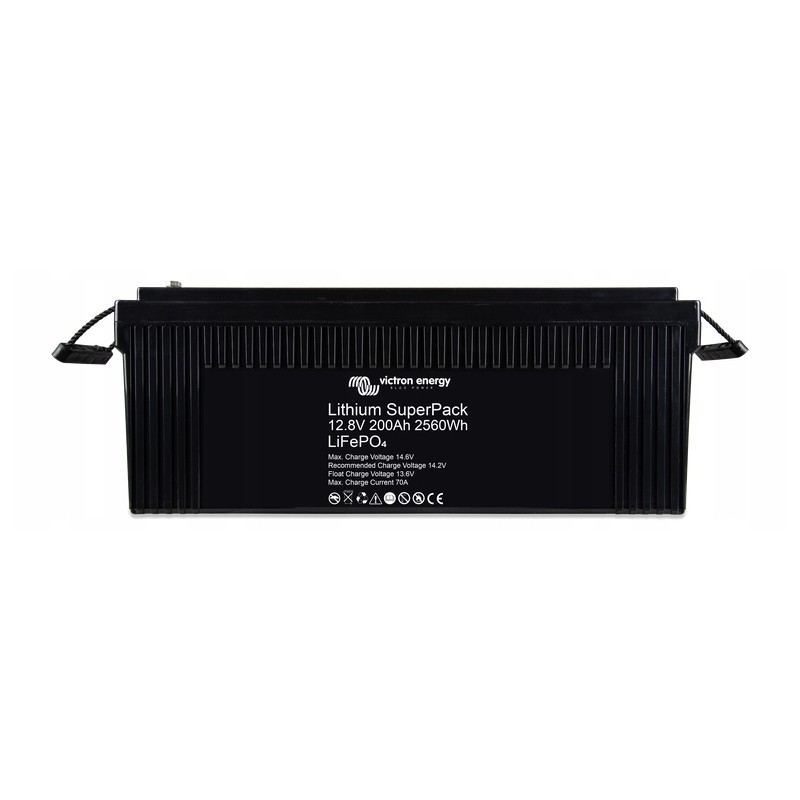
Battery technology: LiFePO4
Nominal battery voltage [V]: 12.8
Battery charging voltage [V]: 14.2 - 14.4
Maintenance charging voltage [V]: 13.5
Minimum discharge voltage [V]: 10
Peak discharge current (10 seconds) [A]: 100
Maximum charging current [A]: 70
Maximum continuous discharge current [A]: 70
Nominal battery capacity at 25 oC [Ah]: 200
Nominal battery capacity at 0 oC [Ah]: 160
Usable battery capacity [Wh]: 2560
Weight [kg]: 31
Dimensions [mm]: 520 x 269 x 208
Lithium SuperPack, LiFePO4, lithium batteries are the safest lithium-ion batteries. The nominal cell voltage in LiFePO4 12.8 V is 3.2 V (lead-acid 2 V / cell) and the entire battery consists of 4 cells connected in series.
Built-in BMS system and safety switch Installing SuperPack batteries is extremely simple and does not require any additional components. An internal switch disconnects the battery in the event of a risk of excessive discharge, overcharging or overheating. Batteries can be connected in parallel. Serial connection is not allowed.
Performance
In some applications (off-grid systems or wind farms), energy efficiency may be crucial. This round-trip efficiency (discharging from 100% to 0% and charging from 0% to 100%) for an average lead-acid battery is 80%. The energy efficiency of LiFePO4 batteries in both directions is as much as 92%.
The charging process for lead-acid batteries becomes particularly inefficient after reaching 80% of the state of charge, resulting in an efficiency of 50% or even less, which may be a problem in the case of off-grid PV systems where several days of energy reserve are required. If LiFePO4 batteries are used, they will still achieve 90% efficiency even under high discharge conditions.
They are very durable Lead-acid batteries fail prematurely due to sulfation if:
They are rarely or never fully charged
They are partially charged or, worse still, completely discharged LiFePO4 batteries do not need to be fully charged to operate efficiently and for a long time. They do not lose their efficiency. Therefore, they work well in places where they are not constantly used, e.g. in caravans, campers on boats or in summer houses at different times of the year. Other advantages include a wide range of operating temperatures, high efficiency also in winter, excellent cyclic parameters, low internal resistance and high energy efficiency. LFP batteries are perfect for use in places with very demanding conditions.