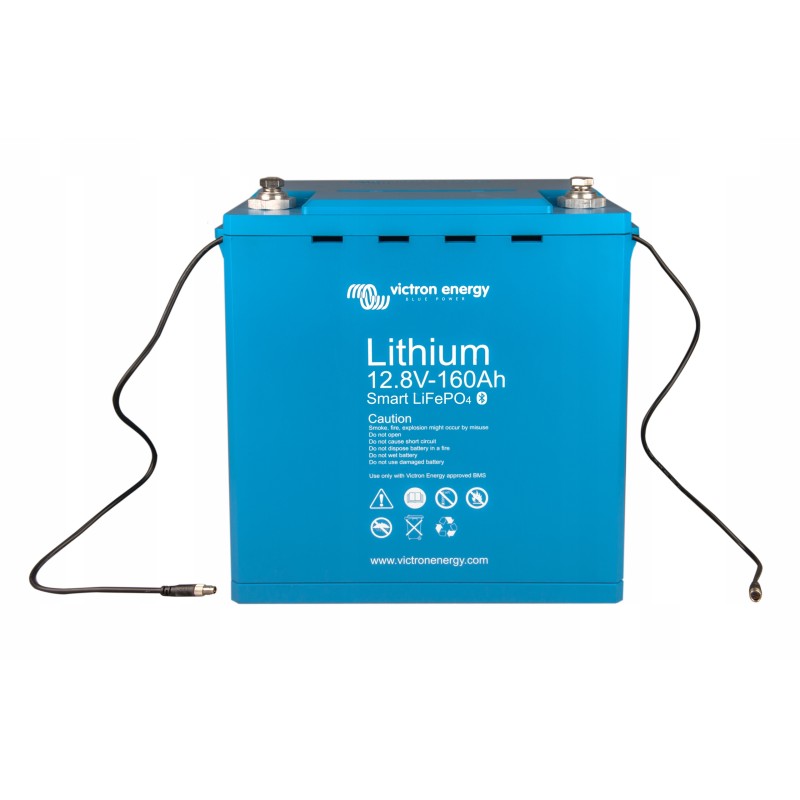
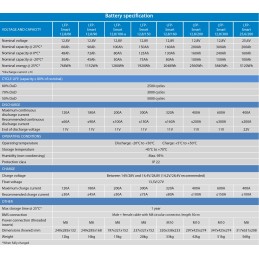
Nominal voltage 12.8V
Capacity (at 25C) 160Ah
Rated energy at (25oC) 2048Wh
Max. continuous discharge current [A]: 200 A
Recommended continuous discharge current [A]: up to 300 A
Dimensions (HxLxW [mm]: 237x321x152 mm
Weight [kg]: 20 kg
Batteries lithium-ion
Lithium-iron-phosphorus batteries (LiFePO4 or LFP) are the safest batteries among lithium-ion batteries. 12.8 V LFP batteries consist of 4 cells connected in series, while 25.6 V batteries consist of 8 cells connected in series.
High quality performance
Lead-acid batteries will wear out prematurely due to sulfation if:
They are operated in an undercharge mode for long periods of time (e.g. if the batteries are rarely or never fully charged)
They are left in an undercharged state or completely discharged (e.g. yacht or camper during winter)
LFP batteries do not need to be fully charged. The service life even increases slightly when the batteries are not fully charged. This is the main advantage of LFP batteries compared to lead-acid batteries. Other The advantages of lithium-ion batteries are: wide operating temperature range, excellent cyclic operation, low internal resistance and high efficiency. This makes these batteries the best choice for very demanding applications.
Efficiency
In some applications (special off-grid photovoltaic and/or wind systems), energy efficiency is a key feature. The overall energy circulation efficiency (discharging from 100% to 0 and back to 100% charged) of average lead-acid batteries is 80%. However, the energy circulation efficiency of LFP batteries is 92%.
The process of charging lead-acid batteries becomes practically inefficient when the charge level reaches 80%. Energy efficiency then drops to 50% or even less in solar systems when an energy reserve of several days is needed (batteries operate at 70-100% charge). In contrast, LFP batteries consistently achieve 90% efficiency with low, uniform discharge.
Dimensions and weight
LFP batteries save up to 70% of surface area and up to 70% of weight while accumulating the same amount of energy.
Cost of purchasing lithium-ion batteries LFP batteries are expensive compared to lead-acid batteries. But for demanding solutions, the high initial cost will be more than compensated by long service life, outstanding reliability and excellent efficiency.
Infinite flexibility
LFP batteries are easier to charge than lead-acid batteries. The charging voltage can vary from 14 to 16 V (as long as the voltage of each cell does not exceed 4.2 V) and the batteries do not need to be fully charged. Thanks to this, you can connect several batteries in parallel without worrying that some are less charged than others.
Should you use or not use a Battery Management System (BMS)?
Important facts:
The LFP cell will be damaged when its voltage drops below 2.5 V (note: sometimes it is possible to repair it by charging with a current below 0.1C)
The LFP cell will be damaged when its voltage rises above 4.2V.
Lead-acid batteries can also be damaged when discharged too deeply, but not immediately . Lead-acid batteries will recover from a deep discharge state even if left in that state for days or weeks (depending on battery type and manufacturer).
The LFP cell does not automatically equalize potentials at the end of the charging cycle. The goals in the battery are not 100% the same. Therefore, as the cycle progresses, some targets will be fully charged or discharged sooner than others. The differences will increase if the goals are not balanced/aligned from time to time. In lead-acid batteries, a small current will constantly flow even when one or more cells are fully charged (the main influence on this current is the breakdown of water into hydrogen and oxygen). This current helps to fully charge other targets that are "left behind", equalizing the state of charge of all cells.
The LFP cell current, when fully charged, is close to zero and therefore some cells are undercharged. Over time, the differences in the charge of individual cells can become so great that the cells will be damaged by deep discharge or overcharge, even though the overall voltage level will be adequate. Therefore, equalizing potentials in cells is highly recommended.